
Orbital Computing and the Energy Constraints of AI
Why experiments in space-based data centres reveal how energy is becoming the defining constraint of artificial intelligence.

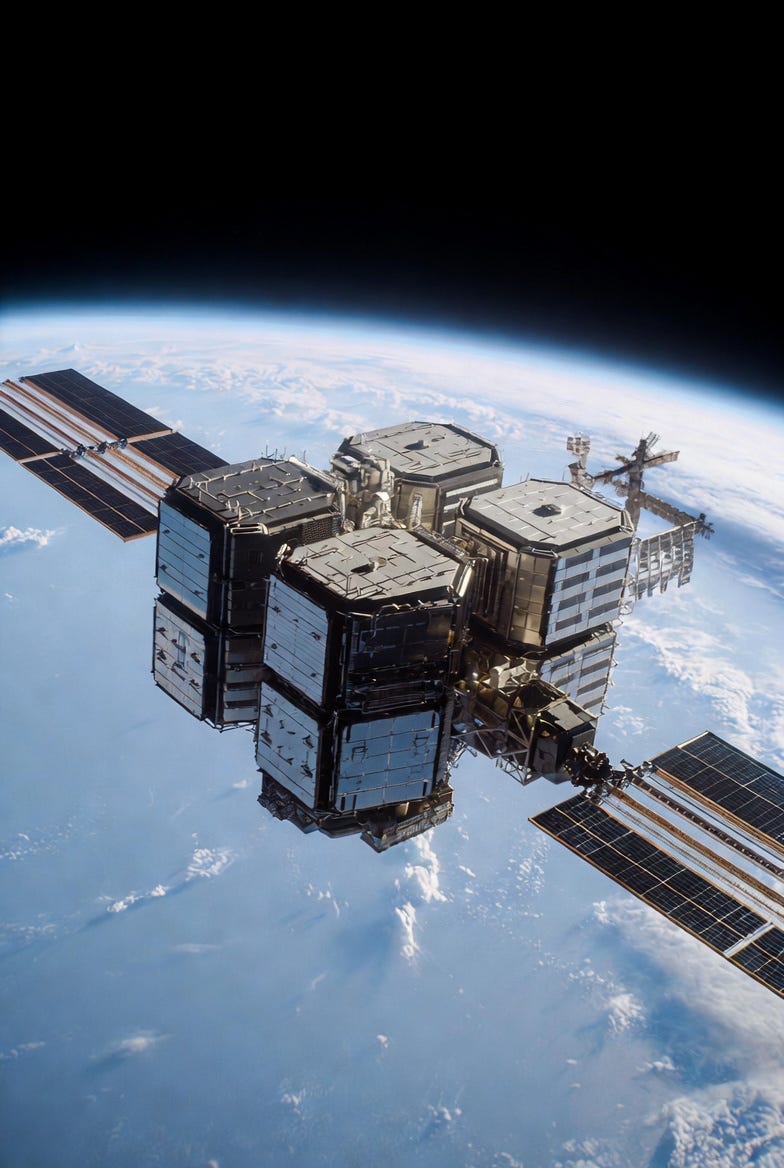
Why experiments in space-based data centres signal a deeper shift in how we think about power, infrastructure and scaled intelligence
SpaceX is hiring engineers to design data centres in orbit. Axiom Space has placed an orbital data centre prototype on the International Space Station. Start-ups have operated high-performance AI chips in low Earth orbit. China has launched early satellites intended to support space-based computing infrastructure.
None of these efforts is commercial at scale. They are early experiments, technically ambitious and economically unproven.
There is no widely accepted industry term for this emerging category of infrastructure. For clarity and consistency, this essay will use the term orbital computing to describe the idea of running significant computing workloads beyond Earth’s surface.
Launching hardware into orbit remains expensive. Cooling in space requires radiating heat rather than relying on air or water, which demands large surface areas and careful thermal engineering. Radiation hardening and hardware replacement cycles add further cost. At present, orbital computing is a test of feasibility, not a deployed alternative to terrestrial data centres.
And yet serious companies and governments continue to invest in it.
The question is not whether data centres are about to leave Earth. It is why credible actors believe this domain is worth exploring.
The answer begins with energy.
AI Has Made Energy Visible Again
For years, the digital economy felt detached from physical constraint. Software scaled. Cloud services expanded. Data seemed weightless.
Artificial intelligence has changed that perception.
Training and operating large AI systems requires enormous amounts of electricity and produces substantial heat. Data centres are not simply server warehouses. They are energy conversion facilities that transform electricity into computation while managing the resulting thermal load.
Every computation increases entropy. Every increase in entropy produces heat. If heat cannot be dissipated, performance degrades. That is not a design flaw. It is physics.
AI has industrialised intelligence, and industrial processes are governed by energy.
The Growth Tension
It would be wrong to suggest that Earth cannot power AI. Renewable capacity is expanding. Nuclear power provides stable baseload. Fusion research continues. Grids are modernising.
The issue is not technological impossibility. It is structural pressure.
Energy infrastructure grows through planning, financing, permitting and construction. AI capability improves through research, hardware scaling and deployment. Both operate on industrial timelines. Yet AI workloads are increasingly concentrated in hyperscale facilities that draw enormous power from shared systems.
Electricity allocated to large AI data centres must coexist with residential demand, manufacturing, electrified transport and climate transition goals. Even clean energy must be distributed across competing priorities.
Energy markets are elastic and grids do expand. But expansion requires coordination, capital and time.
Orbital data centre experiments should not be read as an indictment of terrestrial renewables. They are a signal that AI growth is significant enough to justify exploring additional energy domains.
Why Space Enters the Conversation
Space offers one clear advantage: solar energy in orbit is abundant and near continuous. There are no clouds, no night cycles and no competition for land. Energy generation and computation can be colocated, potentially reducing strain on terrestrial grids.
Proponents argue that if launch costs fall significantly and hardware can operate reliably in radiation-heavy environments, certain energy-intensive workloads such as large model training or batch simulations could be run in orbit.
Critics rightly point to the hurdles. Launch costs remain high. Radiative cooling in a vacuum requires extensive surface area, since heat must be emitted as infrared radiation rather than carried away by air or water. At large scales, the mass of solar panels and radiators could be substantial. Orbiting systems such as the International Space Station and thousands of satellites already use radiators, heat pipes and managed energy loads to regulate temperature in vacuum. The physics is proven. What remains uncertain is whether cooling can remain efficient and economically viable at the far larger scales required for gigawatt-level data centre infrastructure. Maintenance and hardware replacement cycles are also more complex than on Earth.
These are not minor engineering details. They are central economic variables.
Whether orbital data centres become competitive depends on launch economics, hardware durability and power density improvements. It is entirely possible that the economics never close at scale.
But uncertainty does not make the experiments irrelevant.
A Civilisational Lens
In 1964, astronomer Nikolai Kardashev proposed measuring civilisations by the energy they can harness. Humanity has not yet reached Type I status, meaning we do not use all available planetary energy.
Artificial intelligence makes this framing concrete. As intelligence scales, it exposes the energy envelope within which it operates.
Orbital computing is not destiny but an experiment in expanding that envelope.
It is one of several possible responses to energy pressure. Others include more efficient chips, advanced cooling systems, distributed computing architectures and accelerated renewable build-outs.
Space is not the answer. It is a question.
How far are we willing to expand infrastructure to sustain scaled intelligence?
The Strategic Dimension
Energy has always shaped economic and geopolitical power. Coal powered industrial empires. Oil reshaped global politics. Electricity transformed manufacturing and communications.
Artificial intelligence introduces a new layer. Compute capacity influences productivity, scientific advancement and defence systems. If compute scales with energy, then access to resilient and expandable energy systems becomes strategically significant.
Companies and nations experimenting with orbital computing are not predicting dominance. They are hedging against constraint.
Energy strategy and AI strategy are beginning to converge.
What This Really Signals
Orbital data centres may remain niche. They may serve specialised workloads. They may prove too expensive relative to terrestrial alternatives.
Or they may, under the right economic conditions, become part of a hybrid model where Earth hosts user-facing systems and orbit supports the most energy-intensive tasks.
The outcome is uncertain.
What is clear is this: artificial intelligence has made energy visible again.
The cloud was never intangible. It was always built on power.
The emergence of orbital computing is not proof that Earth cannot sustain AI. It is evidence that scaled intelligence is pressing against existing energy frameworks.
That pressure, more than rockets or satellites, is the real story. In that sense, orbital computing is less about leaving Earth and more about understanding the limits within which intelligence must operate.